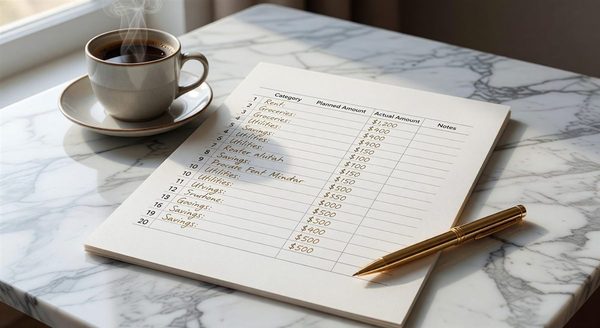
The envelope budgeting method is one of the oldest budgeting systems still in regular use, and it persists for the same reason it worked in 1955: a physical empty envelope is harder to ignore than a slightly negative number in a banking app. The method assigns cash to labeled envelopes — groceries, gas, dining out, personal care — and when an envelope is empty, that category of spending is over for the month. No transfers, no overdrafts, no “I’ll just put it on the card and figure it out later.”
Behavioral economists have a name for why this works: it is called the pain of paying. Handing over a $20 bill produces a small psychological cost that swiping a card does not. A 2022 study in the Journal of Marketing Research replicated earlier findings that cash users spend an average of 12 to 18% less than credit card users on identical shopping baskets, even when both groups had the same available funds. The friction of cash creates a built-in spending governor.
For women rebuilding finances after debt, divorce, or a career interruption — situations where the Federal Reserve consistently finds women overrepresented in survey data — the envelope method’s main advantage is not the cash itself but the unambiguous feedback. The envelope is full or it is empty. There is no interpretation required.
Where did the envelope method come from?
The system predates personal finance influencers by several generations. Households in the early and mid-20th century, before credit cards were widespread, routinely divided paychecks into labeled envelopes or tin canisters — rent, food, coal, doctor, school. The method’s modern revival in the 1990s came largely from Dave Ramsey, who promoted it as the centerpiece of his debt-payoff system, but the underlying behavior is older than any branding.
The current version, popularized through books, YouTube channels, and “cash stuffing” social media communities, is essentially the same system with prettier binders.
How does the envelope method work in practice?
The setup follows four steps:
Step 1: Identify variable spending categories. Fixed bills — rent, utilities, insurance — are not envelope categories. They are paid by transfer or autopay. Envelopes are for variable spending: groceries, gas, dining out, household supplies, personal care, entertainment, clothing, kids’ activities.
Step 2: Assign a monthly amount to each envelope. This is usually done as part of a zero-based budget. If groceries are $600 per month, the grocery envelope gets $600.
Step 3: Withdraw cash on the first of the month. Stuff each envelope with the assigned amount.
Step 4: Spend only from the envelope. When the envelope is empty, that category is paused until the next month. Borrowing from other envelopes is allowed but discouraged.
Does the envelope method still work in 2026?
The behavioral science is unchanged — cash still creates more friction than digital payment. But the practical landscape has shifted in three ways.
Cash use has declined sharply. Federal Reserve payment system data from 2023 showed cash made up only 18% of transactions, down from 31% in 2016. Many groceries, gas stations, and most online purchases are not cash-friendly anymore.
Some merchants charge cash surcharges or refuse cash entirely. Several states have laws against this, but enforcement is uneven.
Digital envelope systems now mimic the same psychology. Apps like Goodbudget and YNAB use category-based balances that behave like envelopes. Some banks offer “spending pots” or “buckets” that segment a checking account into named sub-balances.
The result is that pure cash envelope budgeting works best for variable in-person spending — primarily groceries, gas, personal care, restaurants, and discretionary shopping — while digital envelopes handle the rest.
Who benefits most from envelope budgeting?
Three groups consistently report the strongest results from the envelope method.
People paying off debt. The hard stop of an empty envelope prevents the “just this once” purchase that derails payoff plans. Combined with strategies for how to stop overspending, it can dramatically compress debt timelines.
Visual or tactile learners. Numbers in an app do not produce the same urgency as a physically empty container. People who do better with concrete feedback tend to thrive on the method.
Households recovering from financial chaos. When budgets have failed repeatedly, the bluntness of cash envelopes provides clarity that abstract budgeting rules do not.
Who does it not work for?
The method fits poorly for high-income earners with primarily digital lifestyles, frequent online shoppers, business travelers who cannot use cash for hotels and rentals, and anyone whose spending is concentrated in non-cash channels. It also poses safety concerns — carrying large amounts of cash, particularly in dense urban areas, introduces risk that a debit card does not.
A common compromise is a hybrid envelope system: cash for groceries, restaurants, and discretionary in-person spending; digital “envelopes” or sub-accounts for everything else.
How much should each envelope hold?
Standard percentage benchmarks from consumer finance research, drawn from Bureau of Labor Statistics Consumer Expenditure Survey data, suggest:
- Groceries: 10 to 15% of take-home pay
- Dining out: 3 to 5%
- Personal care: 2 to 3%
- Household supplies: 1 to 2%
- Entertainment: 2 to 5%
- Clothing: 2 to 4%
- Gas/transportation: 5 to 10%
These are starting points, not prescriptions. A rural household with long commutes will weight transportation higher; an urban transit user will weight it lower.
What about safety and convenience?
Three practical guardrails reduce the downsides:
Carry only the day’s expected cash, not the full month’s envelopes. Keep the rest in a secure location at home, ideally a fireproof small safe. Take a photo of each envelope’s contents at the start of the month for insurance documentation. Replace pure-cash envelopes with prepaid cards or sub-account cards for any category that involves large transactions.
Frequently Asked Questions
Do I need to use literal envelopes?
No. Any container works — small zippered pouches, binders with card slots, glass jars, or labeled coin purses. The category and the limit matter; the container does not. Many practitioners use cash binders with clear plastic slots that double as a visual tracker.
Can I do envelope budgeting with a debit card?
A debit card connected to a single checking account does not produce the envelope effect because all categories share one balance. Some banks offer multiple sub-accounts or “buckets” with their own balances, which approximates the envelope system digitally. Apps like Goodbudget and YNAB are explicitly designed to mimic envelopes with digital balances.
What happens to leftover cash at the end of the month?
The standard approaches are to roll it forward to next month’s envelope, transfer it to savings, or apply it to debt. Some practitioners create a “rollover envelope” for slack across categories. The least useful option is to treat it as found money — that defeats the point of the system.
Is envelope budgeting compatible with credit card rewards?
It can be, with discipline. A common hybrid pays for envelope-category purchases with a rewards credit card and immediately moves the cash from the envelope to a “credit card payoff” envelope. The card is paid in full from that envelope each month. This captures rewards without losing the discipline, but requires more effort than pure cash.
How is envelope budgeting different from zero-based budgeting?
Envelope budgeting is a specific implementation of zero-based principles, using physical cash to enforce category limits. All envelope budgets are zero-based, but not all zero-based budgets use envelopes. The envelope method is essentially the cash-enforced version of zero-based budgeting.
Will banks let me withdraw the same amount of cash every month?
Yes, but withdrawals over $10,000 trigger federal reporting requirements (designed for anti-money-laundering, not as a restriction on the depositor). For most households, monthly cash withdrawals fall well below any threshold of concern.
Can the envelope method work for couples?
Yes, and many couples find it works better than other systems because the categories are concrete and shared. Some couples maintain joint envelopes for shared categories (groceries, household) and individual envelopes for personal categories (clothing, hobbies). Transparency tends to reduce money arguments because there is nothing to interpret.